Lockwood Loudspeakers Joins the Actual Power Family
The British point-source monitors that shaped the sound of Abbey Road, Olympic and Trident are coming to Turkey. Actual Power is now the Turkish distributor for Lockwood Loudspeakers.
We are proud to announce that Lockwood Loudspeakers is now represented in Turkey by Actual Power. Lockwood is one of the quietest legends in British audio: a company whose cabinets sat in the control rooms where a remarkable share of the twentieth century's best-known records were made, and which still builds them the same way, by hand, in the UK.
A carpenter, a television broadcast, and the BBC
The story starts in the 1930s with Stanley Timms (1909–1978), a carpenter who watched the first UK television broadcast in 1936 and decided the sound deserved better than it was getting. He began building loudspeakers with one stated aim — that they should sound, in his words, truly musical and convincing. The work brought him to the BBC, and the partnership that followed produced the Lockwood monitor: a cabinet that became standard issue in television, radio and recording studios around the world.
By the 1960s the Lockwood Major was the reference in the control rooms at Abbey Road, Olympic, Chappell and Trident. The list of records mixed on Lockwoods reads like a history of modern music — The Beatles, David Bowie, Queen, Lou Reed, Led Zeppelin, Bob Marley and the Wailers, Black Sabbath. Some of the engineers took them home: Elton John and Pete Townshend both owned custom-cabinet pairs. It is a heritage that no marketing department invented, and one Lockwood has never had to shout about.
One driver, one point in space
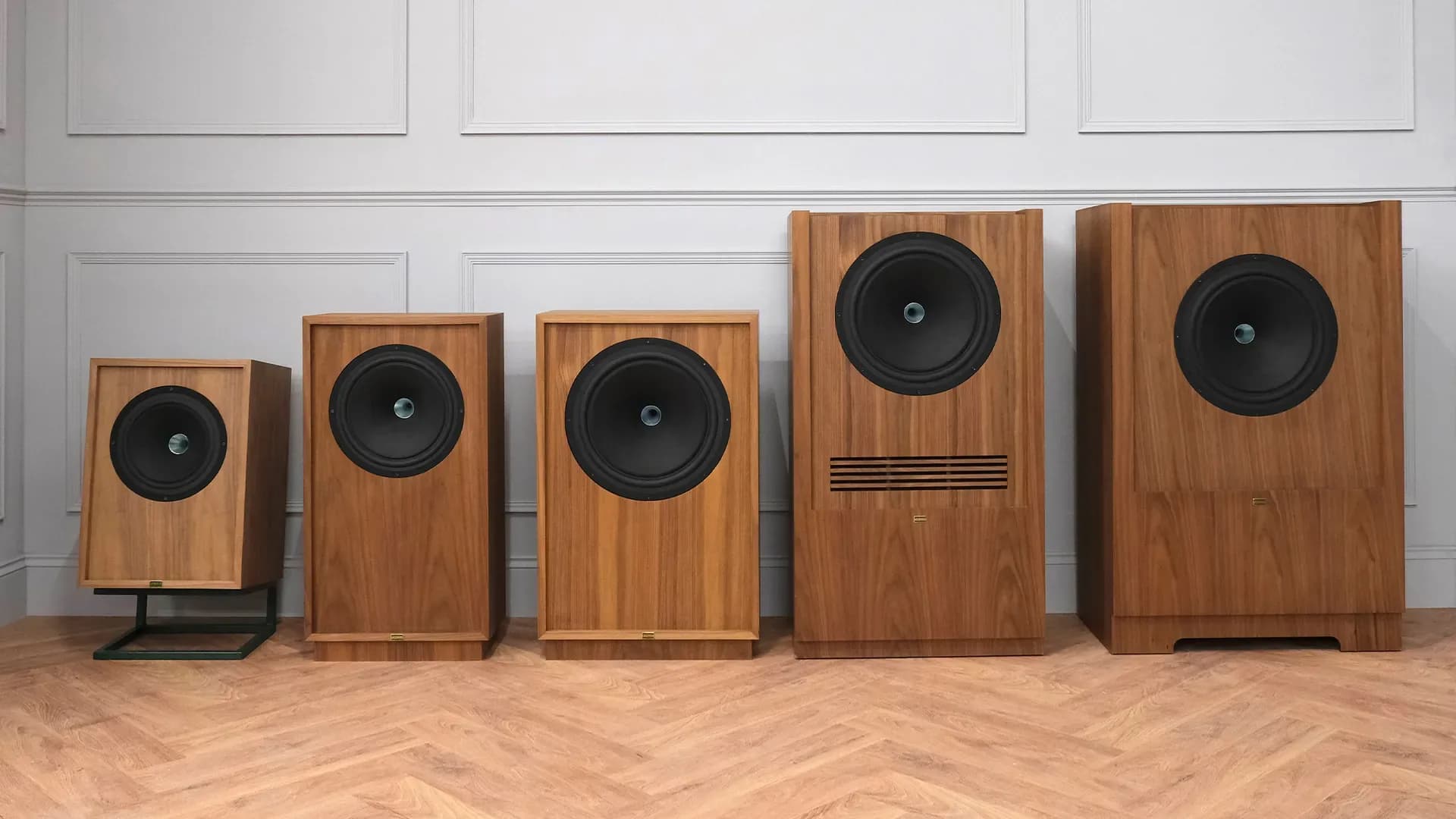
Every Lockwood is built around a single point-source drive unit — the Lockwood Green HPD/SL — in which high and low frequencies radiate from the same point. Nothing is split across two boxes of air, so the music arrives at the listening seat as one coherent event rather than as parts that have to be reassembled by the ear. That is the quality a monitor is bought for: time coherence, low colouration, and voices that sound like people. Behind the driver sits a hand-built A Series crossover with OFC internal wiring, in an 18 mm birch ply cabinet finished in walnut veneer. Everything is assembled in Britain.
The range
Eight models, all sharing that one design principle — from the floorstander that defined the studio standard down to a compact monitor you can specify in any Pantone colour you like.
- Major — the 15-inch studio reference standard, launched in the 1960s and still the flagship
- LE1 — 15-inch point source in a narrower floorstanding cabinet, holographic imaging its calling card
- Academy II — the pinnacle of the Academy design, 15-inch driver in an infinite-baffle cabinet under a metre tall
- Academy 1 — a 12-inch point source for smaller rooms
- Mini — the 10-inch broadcast monitor, developed for the BBC, ITV and Neve Electronics
- Universal Stanley 2 — 5-inch Alnico point source in a sealed floorstanding cabinet, any Pantone colour
- Universal Stanley 1 — the compact sealed stand-mount, small by design and mighty by heritage
- Mini Major — Dave Harries' 1968 Abbey Road design, reborn as a numbered edition of 984 pairs
On their way
The full range can be ordered through Actual Power from today, and the first demonstration pairs are on their way to us. If you would like to hear a point-source monitor do what it does — particularly on the recordings that were made on them — let us know and we will be in touch as soon as they land.
Welcome, Lockwood. Hear what they heard.